
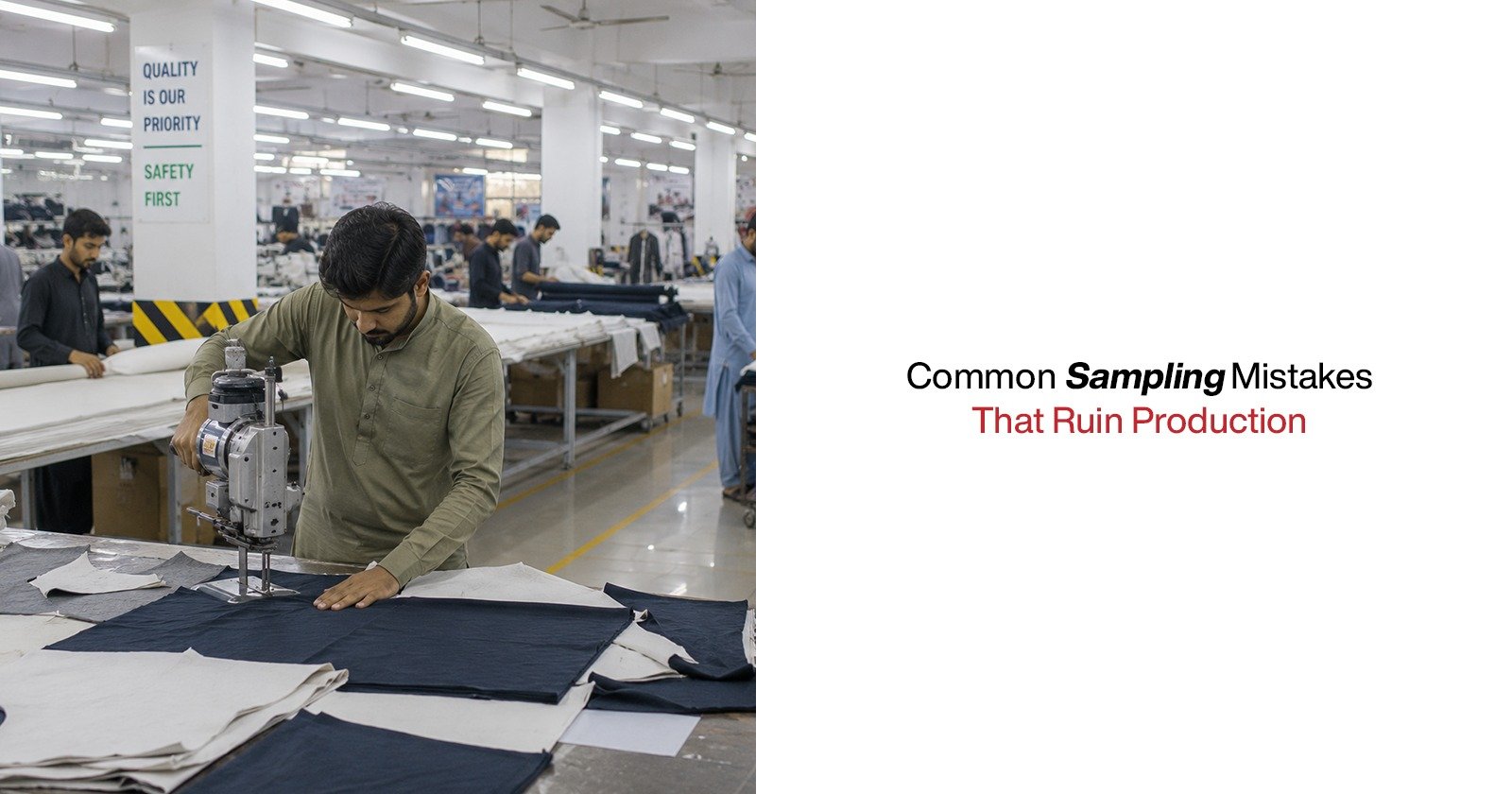
Sampling is one of the most important stages of apparel manufacturing. Before the bulk production begins all designs, measurements, stitches, fabrics, trims and finishing details have to be carefully checked through various sample stages. A good sampling process reduces the chances of production risks, waste and miscommunication and ensures the buyer gets exactly what he expects.
Unfortunately, many clothing brands (especially new and growing fashion businesses) do not value sampling. They often rush through approvals, ignore small inconsistencies, or don’t communicate changes well. Such seemingly minor errors can result in costly production delays, rejected shipments, poor product quality and unhappy customers.
When a brand knows the most common sampling mistakes, they can develop better manufacturing processes and protect their investment. In addition to small-scale clothing production, these mistakes are to be avoided when you run a huge international production. It is essential for the quality of the product.
Why Sampling Matters Before Bulk Production
Sampling is the template for manufacturing. Approved samples are the standard for quality, measurements, sewing construction, fabric behaviour, trims, printing, embroidery, washing and finishing for each production team.
If the sample is not properly approved, manufacturers must make assumptions. Even experienced factories cannot accurately replicate a garment when important specifications are not clear. Sampling removes the guess work and ensures that all stakeholders are working to the same expectations.
A good sampling process also allows buyers to catch problems when they are inexpensive to fix, rather than after thousands of garments have been produced.
Mistake 1: Skipping the Development Sample Stage
Some brands want to save time and go straight from design sketch to production. This is one of the greatest mistakes in garment manufacturing.
Development samples are used to prove that a design can actually be manufactured. During this phase, manufacturers identify construction challenges, suggest alternate sewing methods, suggest appropriate fabrics and improve production efficiency.
If you skip this step you will often find yourself making very expensive changes during production.
Mistake 2: Using Incomplete Tech Packs
A tech pack is the language that bridges buyers and manufacturers. In the absence of specifics, there is bound to be confusion.
Many production problems begin because there is a lack of important information. There is room for interpretation if measurements are incomplete, stitch details are unclear, artwork dimensions are missing, fabric specifications are absent, or trim instructions are vague.
Each approved sample must be accompanied by a complete technical package which will include measurements, grading, sewing details, colour references, labelling instructions, packaging requirements and quality standards.
Mistake 3: Ignoring Fabric Performance
A garment may be perfect in the sample but it will behave very differently after washing or regular use.
Some brands accept samples without checking for shrinkage, colour fastness, fabric recovery, pilling resistance or stretch performance. As a result, by the time they reach consumers, clothes can shrink too much, lose their shape, fade quickly or develop faults.
With proper fabric testing when sampling, these quality issues don’t occur before production.
Mistake 4: Approving Samples Too Quickly
Buyers are often pushed to approve samples without proper inspections due to deadlines.
In the rush to approve you may miss uneven stitching, inaccurate measurements, bad workmanship, loose threads, fabric flaws, or inaccurate colour matching. Once production begins, it’s expensive and time consuming to fix these problems.
All samples shall be approved by inspection under proper lighting, measured and checked against the original specifications.
Mistake 5: Poor Communication Between Buyer and Factory
Manufacturing needs constant communication.
Many production failures come from the customers’ verbal directions rather than written confirmations. Others accept changes via messaging apps, and do not update the official documentation.
All modifications are to be well documented with an updated technical drawing, measurement charts, comments, and approval records. This will lead to accountability and prevent misunderstandings throughout the production.
Mistake 6: Not Testing Fit on Real Models
One of the main drivers of customer satisfaction is fit.
Some companies only approve samples using mannequins or flat measurements. But on real people with different body types and movements garments behave differently.
Correct fit models should be tested with fit samples. Static inspections do not detect fitting problems that walking, sitting, stretching and normal body movements will reveal.
Good fit corrections during sampling increase customer satisfaction significantly post launch.
Mistake 7: Overlooking Trim Quality
Buttons, zippers, elastic, drawcords, labels, snaps and other trims may seem a small detail, but they go a long way in garment quality.
Lower trims tend to break before the garment is even compromised and thus ruin the brand’s reputation.
During sampling, each trim should be tested for durability, functionality, colour consistency, attachment strength, and fabric compatibility with the garment.
Mistake 8: Ignoring Measurement Tolerances
No manufacturing process produces perfect garments. Small deviations in the measurement are normal.
However, many buyers do not specify acceptable tolerances or expect zero variation, which causes unnecessary production conflicts.
Well-defined tolerance charts enable manufacturers to set attainable quality standards, and to maintain product uniformity in mass manufacturing.
Mistake 9: Not Reviewing Wash and Finishing Results
After sewing, many garments are washed, dyed, enzyme-washed, garment-dyed, stone-washed or softened.
If samples are approved by buyers before these finishing processes, the final production may look, feel and be a different size altogether.
Approval should always be on finished garment not on unfinished samples.
Mistake 10: Failing to Approve a Pre-Production Sample
The pre-production (PP) sample is a true copy of what the factory will produce in the bulk order.
Some brands cut this vital step to save time. Unfortunately, there can be noticeable differences from earlier samples due to small variations in fabric lots, trims, machinery or operators.
A PP sample approval makes sure that everything is in place and the production line can deliver the quality you expect before you go into mass production.
Mistake 11: Changing Specifications During Production
Frequent design changes, even after production has started, often confuse many departments.
If revisions are not managed properly, pattern makers, cutting teams, sewing operators, quality inspectors, and packaging staff may receive conflicting information.
Production must be suspended until revised specifications have been formally approved and distributed if changes are necessary.
Mistake 12: Focusing Only on Cost Instead of Quality
Some buyers ask for repeated cost cuts during the sampling.
The lower prices often mean substituting fabrics, simplifying construction, changing trims, or reducing quality standards. These trade-offs might not be apparent at first glance but can have a big impact on durability and customer satisfaction.
Good brands don’t chase the cheapest manufacturing price, they balance manufacturing costs with the long-term quality of the product.
Building an Effective Sampling Process
This sampling workflow is well organized and dramatically improves production efficiency.
Successful apparel brands have clear stages of approval, detailed documentation, multiple quality inspections, thorough testing of fabrics, verification of measurements, careful fit review, and consistent communication with their manufacturing partners.
This form of systematic work reduces production errors and improves delivery schedules and customer satisfaction.
Manufacturers benefit too, because they get clear instructions that remove doubt and allow production teams to focus on good execution rather than fixing avoidable mistakes.
How TexNex Inc Helps Buyers Avoid Sampling Problems
Choosing the right manufacturing partner is a large part of avoiding sampling errors. TexNex Inc connects buyers in North and South America with trusted manufacturers in Pakistan from its base in Canada. Their team provides clear communication between buyers and factories, ensuring sampling requirements are clear before production begins.
One of the biggest advantages of TexNex Inc is its zero commission business model. The company isn’t adding sourcing costs with commissions but instead wants to build transparent relationships between buyers and manufacturers. This allows brands to enjoy professional sourcing support, effective coordination and smoother production management during the sampling and manufacturing processes, as well as competitive factory pricing.
Conclusion
Sampling is much more than prototyping. It’s what the production of successful apparel is based on. With each sample we have an opportunity to identify design flaws, refine construction methods, verify measurements, evaluate fabrics, and establish quality standards before mass production.
Brands that take the time and effort to sample on a regular basis find they have fewer production delays, lower manufacturing costs, increased customer satisfaction and a better relationship with suppliers. Apparel companies can protect their reputation and their bottom line by avoiding common sampling pitfalls and working with experienced sourcing partners.
Frequently Asked Questions
1. Why do we need to sample before garment production?
Sampling enables manufacturers and buyers to verify the accuracy of the design, garment fit, fabric performance, construction quality and production feasibility before committing to mass manufacturing, reducing costly production errors.
2. How many sampling stages usually take place in garment manufacturing?
Development samples, fit samples, size-set samples, sales or photo samples as needed, pre-production (PP) samples and sometimes shipment approval samples depending on buyer requirements, for most apparel projects.
3. What is the biggest mistake brands make with sampling?
The most common mistake is to approve samples without a detailed inspection. Rushed approvals too often lead to measurement problems, construction defects, fabric inconsistencies and quality issues that are far more expensive to fix once bulk production is underway.
Summary
Sampling is one of the most important quality control process of the apparel manufacturing. Production failures can be costly, and common mistakes like incomplete tech packs, rushed approvals, poor communication, lack of fit testing, and omission of pre-production samples can contribute to them. Systematic sampling process enables brands to mitigate risks, improve product quality, reduce costs and receive successful results of manufacturing. Working with seasoned sourcing companies such as TexNex Inc. simplifies the process by linking buyers with dependable manufacturers, optimizing the manufacturing process from conception to delivery.