
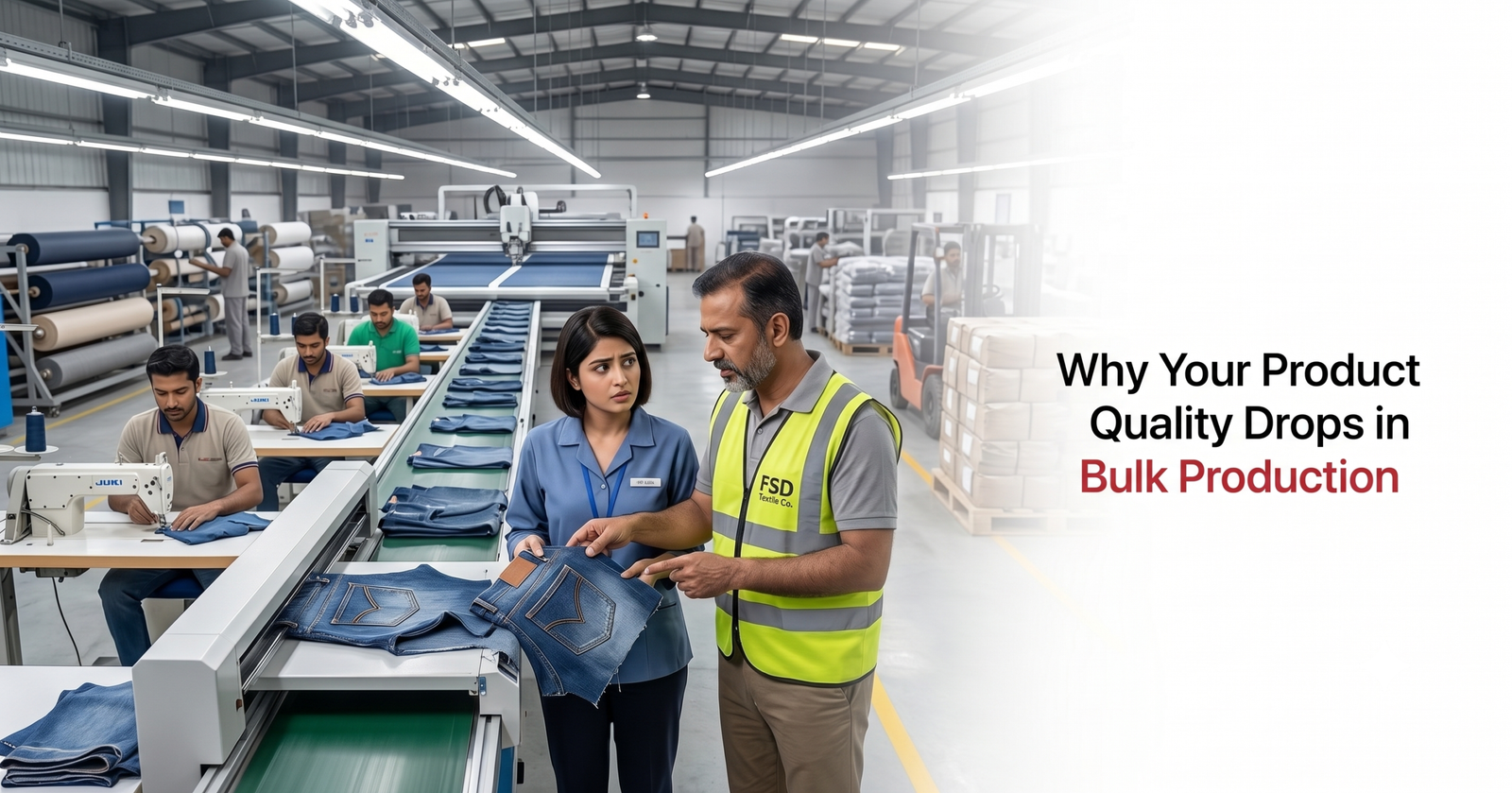
Any business would be thrilled to scale up from a successful product sample to full scale manufacturing. It demonstrates increasing demand, broader market scope and increased revenue streams. But it also poses a problem many brands fail to consider: consistent product quality when producing in bulk.
What looks perfect in sampling may have flaws, inconsistencies or performance issues when thousands of units are produced. Mass production can lead to quality dips more frequently than many companies realize, whether it’s apparel and home textiles or industrial products and consumer goods.
The first step in preventing these costly mistakes is to understand why they happen. Whether you are importing products or manufacturing locally, knowing the reasons for the deterioration of quality will help you build a robust supply chain and save your brand reputation.
The Difference Between Sample Production and Bulk Manufacturing
Sample creation is a well controlled process. Manufacturers will spend extra time, use their best workers and do careful inspections to give you a perfect prototype. Every detail is reviewed because the sample is meant to gain client acceptance.
Bulk production is an entirely different matter.
Manufacturers are not making a handful of units, but thousands or even hundreds of thousands of units, all with tight deadlines. With the increase in volume, there are multiple variables that can affect consistency. The machines are working all the time, the workers are changing shifts, the batches of raw materials are different and the speed of production is increased a lot.
Each of these factors is a potential avenue for quality differences.
1. Inconsistent Raw Materials
The inconsistency of raw materials is one of the main causes for the quality to drop in mass production.
To quickly handle large orders, manufacturers may obtain materials from a number of suppliers. Materials may look alike, but there may be differences in textures, colours, thicknesses, durability, or even chemical composition that affect the final result.
Colour variations in dye-lots can cause significant colour differences for textile manufacturers. Small differences in the quality of thread, or trims can also affect the durability and look of clothes.
Strict inspections of raw materials before production begins help minimize these risks.
2. Production Speed Often Increases
When the production deadlines are tight, factories often speed up production.
While faster production increases output, it can decrease the amount of attention given to individual products. Workers might have less time to check parts; sewing accuracy could decline; finishing might be hurried; and packaging mistakes could become more frequent.
A realistic production schedule means manufacturers can focus on reliability instead of cranking out as many parts as they can a day.
3. Machine Calibration Changes Over Time
Industrial machinery works well if maintained and calibrated well.
In long production runs, machines naturally suffer wear and tear. Cutting equipment can lose accuracy, sewing machines can have tension issues, and printing equipment can have inconsistent results.
If the equipment isn’t regularly calibrated, these small inaccuracies compound across thousands of products.
Such problems are largely eliminated by routine preventive maintenance which also provides uniform quality in large runs of production.
4. Human Error Becomes More Noticeable
Repeat production can cause errors even among experienced workers.
Fatigue, shift changes, gaps in communication, and pressure for production are responsible for human error.
Wrong measurements, bad stitching, missing accessories, wrong labelling or packaging defects for instance.
Even if each mistake seems small, if a mistake occurs in an entire production batch it can cost you.
Workforce training, supervision and standardized operating procedures go a long way in mitigating these risks.
5. Quality Control Is Often Delayed
Many companies think quality inspection is done only after production is complete.
At the end of production, however, if you find defects, thousands of defective products may have already been produced.
Modern manufacturing has many inspection stages.
Raw materials should be checked prior to production.
The work-in-progress should be examined during manufacture.
The completed products must be finally inspected before shipment.
This multi-level quality control process catches problems earlier and reduces costly rework.
6. Poor Communication Between Buyer and Manufacturer
Communication problems are also often the cause of quality inconsistencies.
A buyer may expect one style of stitching but the manufacturer knows another. Packaging specifications are subject to change. The size tolerances may vary from document to document.
Small misunderstandings can lead to big production problems.
Detailed technical specifications, measurement charts, approved samples and written production guidelines keep both parties in sync throughout manufacturing.
7. Changing Suppliers Midway Through Production
As demand rises, some manufacturers change suppliers.
Replacement suppliers may supply similar materials but identical specification cannot always be assured.
This often results in significant variation between batches of production.
Customers who receive products from different lots may see differences in looks, performance or durability which would decrease their trust in the brand.
Utilizing established, reliable suppliers helps ensure product consistency.
8. Lack of Process Standardization
Standardized manufacturing procedures are required for all production lines.
Without documented processes, individual workers may perform the same task differently.
For example, the sewing order, the pressing temperature, the quality checking methods and the packaging steps should be the same regardless of the production amount.
Manufacturing processes which produce consistent products are established through standard operating procedures.
9. Insufficient Production Testing
- The end of product approval is not the end of testing.
- Testing during manufacturing is required for large production runs.
- Measurement confirmation may be needed for garments.
- Textiles may be subjected to colorfastness testing.
- Stress testing may be required for industrial products.
- Packaging may need to be tested for transit.
- Continuous testing finds problems before they spread.
10. Cost-Cutting Measures Can Affect Quality
Sometimes manufacturers cut costs without telling buyers.
To reduce production costs, companies can use lower-grade materials, substitute parts, cheaper packaging or simplified finishing processes, but this is often done at the expense of product quality.
While such choices may seem to save money in the short term, they often lead to more warranty claims, more customer complaints, and more product returns.
Transparent manufacturing partnerships remove many of these risks.
11. Weak Supplier Audits
Not every factory is at the same level of production.
Without regular audits, you could end up buying a company with outdated machinery, an improperly trained workforce, inconsistent quality systems, or poor inventory management.
Factory evaluations at intervals are good insights into manufacturing capabilities prior to production.
12. Production Capacity Limitations
Some factories accept more orders than they can actually handle.
If production is beyond capacity, quality is often the first casualty.
Workers get overworked, inspections get rushed, and deadlines lead to shortcuts.
By selecting manufacturers with adequate production capacity, it’s easier to ensure consistent quality, even in peak seasons.
Why Documentation is Important
The foundation of any successful manufacturing project begins with accurate documentation.
Reference points during production are: purchase orders, technical drawings, approved samples, quality standards, packaging requirements, labelling instructions and inspection reports.
Proper documentation reduces misunderstandings and establishes accountability throughout the manufacturing process.
Building Long-Term Manufacturing Relationships
Jumping from one manufacturer to the next can lead to inconsistent product quality for businesses.
Enduring partnerships allow producers to better understand product expectations, quality standards and consumer preferences.
Over time, communication improves, production becomes more efficient, quality consistency improves.
As a rule, better value over the long term is to build and maintain trusted manufacturing relationships than to always be shopping for lower prices.
How TexNex Inc Helps Maintain Consistent Product Quality
But bulk production is not just about finding a factory. It’s about maintaining the quality of the product. It requires experienced manufacturing partners who understand quality assurance, supplier management and production oversight.
TexNex Inc. is a Canada based clothing manufacturing company connecting buyers in North & South America to trusted manufacturers in Pakistan. TexNex Inc is different from traditional sourcing companies in that we work directly with the manufacturers and we are a clothing manufacturer ourselves. With these direct partnerships the company has better control of the quality of production, communication and the delivery time.
TexNex Inc is a no-commission operating company that develops transparent relationships between buyers and manufacturers. Its hands-on approach helps companies minimize production risks, increase consistency and ensure products meet international quality expectations from first production run through large scale manufacturing.
Conclusion
Bulk production has the complexities that are missing in sample manufacturing. Product quality can decline due to many things, such as producing more, using different materials, wear and tear on machines, mistakes by people, problems communicating and not having enough quality control.
Businesses that invest in reliable manufacturing partners, repeatable production processes, constant checks and clear communication stand a far better chance of keeping quality consistent regardless of order volume. Product quality isn’t just about preventing defects, it’s about protecting customer trust, brand reputation and long-term business growth.
FAQs
1. Why does my sample product look different from the final bulk production?
Samples are each treated separately and produced in controlled conditions, while bulk production involves larger volumes, more workers, continuous machine operation and tighter deadlines. These factors can lead to inconsistencies without quality control.
2. How do I maintain quality consistency on large production runs?
Consistency can be achieved by having detailed product specifications, approved production samples, periodic factory inspections, raw material verification, machine maintenance, continuous quality checks and good communication with your manufacturing partner.
3. Can working with manufacturers directly lead to better products?
Yes. Direct partnerships eliminate communication gaps, enhance production transparency, offer better manufacturing control, and enable faster problem resolution. This often leads to improved consistency of product and tighter quality control.
Summary
In mass production, the quality of the product often declines because of the variability of the raw materials, increased speed of production, wear on the machines, human error, poor communication, weak quality control and supplier related challenges. Companies can fix these problems by standardizing manufacturing processes, inspecting during manufacturing, and working with experienced manufacturers. By working with trusted companies like TexNex Inc. that partner directly with manufacturers and also produce clothing themselves, businesses can ensure consistent quality and simplify global manufacturing through a transparent, zero-commission approach.